Saturday, February 19, 2011

Medicine Show


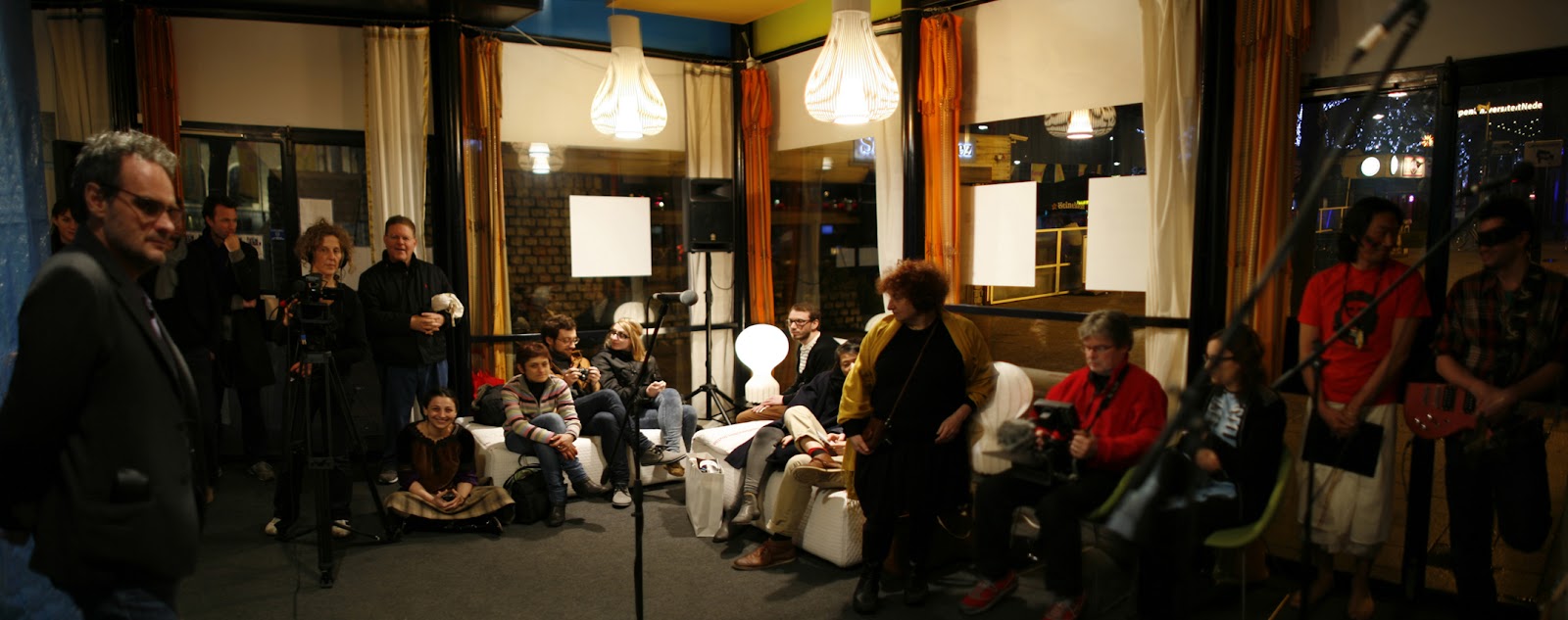
Paola Pivi's GRRR JAMMING SQUEEK in collaboration with Sculpture International Rotterdam invites A Constructed World and Speech and What Archive to perform and record with guests Steve Piccolo and Michele Robecchi


Photo : Attilio Maranzano

Tuesday, January 4, 2011

Notes Toward a Sympathetic Approach


From the first of these principles, namely the Law of Similarity, the magician infers that he can produce any effect he desires merely by imitating it: from the second he infers that whatever he does to a material object will affect equally the person with whom the object was once in contact, whether it formed part of his body or not. [...] Both [principles] assume that things act on each other at a distance through a secret sympathy, the impulse being transmitted from one to the other by means of what we may conceive as a kind of invisible ether.

-Sir James Frazer, The Golden Bough

Why do I find it beneficial to invoke—within the context of a group of artists, writers and curators assembled to consider issues surrounding speech acts and their documentation—a Scottish anthropologist’s theorization of magical practice dating from the early 20th century? First of all, I want to say that my intention here is not to simply replace the word “magic” with the word “art” as a kind of analog for the agency of the art object (although, when considered as a kind of materialist practice, Frazer’s notion of “sympathetic magic” preserves the agency of individual actors within a broader system of exchange). Nor do I wish to substitute the word “artist” for “magician,” thereby reproducing notions of artist-as-shaman, possessed though some inexplicable power by the secrets of the natural world. This kind of mystification would be extremely dubious, especially given the collective work of the Speech and What Archive. Instead, I want to invoke sympathetic magic as a potential way to reconsider the hierarchies that we have inherited from narratives that set the truth of reality against the falsity of its representations.

Frazer’s theorization of sympathetic magic thinks a world in which images/objects do not represent the things they depict, but rather are understood to be valences of them, distributed through a spatiotemporal network of sympathy and contagion. In other words, rather than reduced to a false image or a “mere” representation, the sympathetic image/object (in its life as material and image), is thought to contain something of the thing itself. It seems to me that this is how sympathetic magic can be productive with respect to discussions of documentation. Because, although it accepts causal relations, it resists a strictly ontological understanding. That is, it does not privilege reality over its image, nor the original event over its documentation. Instead, it prefers to concern itself with processes of transmission and translation, material contexts, embodiment and affective response. It is in precisely this way that the notion of sympathetic magic can provide an alternative to the document’s evidentiary capacities and internal problematics of truth/falsity, past/present and subject/object. The same kind of operation can be described with regard to the archive’s function as a representative totality. Instead of exhibiting the anxious drive to record, represent and preserve the way something really was (whether it be a person, an event or an epoch), a sympathetic approach in fact anticipates a fundamental instability, contradiction and loss. Nothing is true, everything is real. As part of a shared space of not-knowing, it becomes a generative framework, relying on the continued articulation of a collective memory, a contagious and excited state of fragmentation and contact. 
Matthew Rana

Tuesday, November 16, 2010

Paris, explaining eels to contemporary art


On Friday Nov 12, A Constructed World invited Sébastien Pluot and Fabien Vallos (from SWA) and guest Sophie Auger to made a conversation about eating eels. This aperitivo event signified the end of 'Explaining contemporary art to live eels #6' an event curated by Pluot at Villa Arson earlier in the year.

Wednesday, October 13, 2010

London meeting


Speech and What Archive met at One Marylebone in London on October 16 for a conversation about ...


Sunday, October 10, 2010

Biennale de Belleville

Speech and What Archive performed, read, spoke and sang in the Speakeasy Medicine Show, an ACW event, at the Biennale de Belleville on 9 October.

A Floating Conversation
Performance #31 & 32, Adam & Eve
COLD Trailer
Vespétro
The Gift of Nothing
Lenny Bruce Monologue
The Nice Choir

Belleville meeting


Biennale de Belleville

The group met in Paris for four days. There was several meetings, rehearsals, two diners, and a night out in a bar of my neighborhood with lots of beer. It was good that even though we did'nt all knew each other, I felt that people sort of jumped in and accepted right away the presupposition of working in the context of the paper room event. It felt much more easy to speak together. Marie talked about common memory, which I guess is the reason why I am writing those words now. Anna talked about her editing projects, and about the kite that she had made in Bordeaux, and that had traveled to Melbourne the year before. Jesper talked about speaking to trees and to plants, the healing power of nature, and he had the project to take back in sweden with him a small tree from Paris that all of us could tell our faults and dark secrets to. Then in Sweden he would plant it in the ground to grow. I wonder if you can take a plant on a plane though. Matthew talked about performance and comedians, and Lenny Bruce of which he re-enacted bits of a performance he had once learned by heart. It was good to spend some time together an to make something together. I liked that other people were sort of connected to us in a way, as if we were part of a larger group. What I remember the most was the event itself, that seemed to fly by, and the tap dancing, and the singing. Especially the singing.
Clemence de Montgolfier

Friday, October 1, 2010

Speech and What Archive 2010

After a number of informal meetings in Paris and Linköpings, Speech and What Archive has come together again to make their second series of meetings, events and exhibitions. The group is Marie Gautier, Anna Hess, Clémence de Montgolfier, Sébastien Pluot, Fabien Vallos, Etienne Bernard, Olivia Barrett, James Deutsher, Jesper Frilund, Yann Sérandour, Matthew Rana and ACW.

Tuesday, June 1, 2010

Melbourne Flottante Exhibition Documentation


Melbourne Flottante
Y3K Gallery
Melbourne
April-May 2010

Monday, April 5, 2010

Speech and What Archive? Melbourne Flottante

Opening Saturday the 10th of April from 18-20h

Speech and What Archive? began on a floating house on a river in Chatou at the invitation of A Constructed World. In Melbourne Flottante, we continue to consider what is kept and why it is kept, how things may be mapped, traced or stored, the possible shape and content of an archive, who may speak and what is kept unsaid, and generally what is privileged in culture so that it is available to the future.
The exhibition is composed of a presentation element, where objects that in some way act as archives will be exhibited at Y3K, and archive development, where the curators will work on methodologies of archiving and re-presentation for the duration of the show.

Speech and What Archive? Melbourne Flottante is curated by Marie Gautier and Anna Hess (Paris) and Liv Barrett and James Deutsher (Melbourne) with the support and counsel of A Constructed World.

Speech and What Archive is a project of A Constructed World. This project was made possible with funding and support from Vision Forum and Linköping University; CNEAI, Chatou; Social Practice MFA Program, CCA, San Francisco; and Villa Arson, Nice

Y3K
http://y3kgallery.blogspot.com
205 Young St.
Fitzroy
Melbourne
Australia
3065

Monday, November 30, 2009

Poster Project


The next event of SWA will be sur la Maison Flottante/on the Floating House
Cneai Chatou Sunday 13 December 15h – 18h

Speech and What Archive present a moving, impulsive conversation by twenty-one people looking to find ways to say-what-we-want individually and in a group. What can be said? What will get kept?

a brownie, coffee and cakes, make some cakes, excited, prosecco, dancing is possible

it should have been me, BADLY ARCHIVED, temporary archives, unintended event, lost archive, No archive, burning all, we keep all, Compulsive hoarding, misunderstanding as a form of communication, from Gutenberg til now, hot pyjamas for winter, blackout, structural uncertainty, living archives, incomprehensible democracy, finding my female voice, Ö╖f ╨D}┐ ╜¼ .î ⌡Θ╗╒ 3╪/ε]Z!░|3ß)░√0é(A▓5₧^GT]é)╔YOÆ πÉâÖπ1╩ ▐V°Bv9p|╓┌ ─U=63YNT e£ ( WΓ”3╜0Ü ╝ Rq$+ :àαä2╞ü ΦO”1Pμ Æîë ╘!k º╖ù^╪┘╡ B: ─ 5 Ü ß Ω ╚ ∙ è ½ â 6 ü t ⌠ É l c ╜ 8 ª T ” ? ╕ A Ö¿B}>>╥PZÆòÄm NmU░^█é#«“▒ê█φ^¥╫┬ ▒╟, , To what extent can we trust history upon which our identities are based, Both adverse selection and moral hazards are key factors in designing efficient mechanisms to mitigate climate change, Billie Jean King, manipulated images, elvis greatest, image over text, green circle, be wary of the image, imperative for withdrawal, another person who was thinking about me, black disk folded, if it weren't for the prison we'd know we were in the prison, withdrawal, battery as a gift, suspended space, restriction and flow, take your place take your space, I have been told that it was not all about saving, what can be yet to come in a world that is absolutely full, the internet is like a disorganized archive, if everything were accessible the world would be an archive.

Posters by Speech and What Archive (ACW, Liv Barrett, Etienne Bernard, James Deutsher, Christelle Foucoulanche, Marie Gautier, Anna Hess, Marie Husson, Clémence de Montgolfier, Sébastien Pluot, Pelin Uran) and invited artists Amy Balkan, Malak Helmy, Lynne McCabe and Ruth Robbins, Allison Rowe, Ted Purves, Nancy Nowacek, Ann Schnake, Alex Wang, Fred Alvarado