Sunday, June 23, 2013
SWA Meeting 25 June
Speech and What Archive will meet to discuss plans for the Bandits-Mages Festival Bourges, 13-16 November 2013 and an exhibition at La Box, 17 October - 14 November.


Sunday, February 17, 2013
Speech and What Archive workshop 23 & 24 February
Speech and What Archive will hold a two-day workshop to discuss new and ongoing projects.
The agenda includes:
Forthcoming Nature Dances works and peformances
SWA newspaper part 4, dedicated to research related to the Nature Dance project
Partition, writing a score for the project
SWA website development
Individual presentations related to ongoing research
De-brief of recent performances and exhibitions: Cneai Chatou, Ian Potter Museum Melbourne, TCB Melbourne, MCA Sydney, Frac Reims
The agenda includes:
Forthcoming Nature Dances works and peformances
SWA newspaper part 4, dedicated to research related to the Nature Dance project
Partition, writing a score for the project
SWA website development
Individual presentations related to ongoing research
De-brief of recent performances and exhibitions: Cneai Chatou, Ian Potter Museum Melbourne, TCB Melbourne, MCA Sydney, Frac Reims
Tuesday, January 8, 2013
A Constructed World Medicine Show


What The Monkey Says No One Pays Attention To


Speech and What Archive Medicine Show


Eel Dance, Cneai Chatou
Performance for Festival Island #1, 29 September, with SWA, dancers from Centre national de danse contemporain d'Angers (CNDC), Aurélie Goddard and Ludovic Austry.


 Live publication made in situ by SWA, Speech and What Archive Part 3, newspaper printed in an edition of 100 copies.


Tuesday, September 4, 2012
A Floating Conversation, Cneai Paris
A Floating Conversation, performance and book launch of the publication Speech Objects,
January 27, 2012
SWA with ACW and Etienne Bernard and guests Michele Robecchi (in London) and Fabrice Reymond


Publication Speech Objects
-->
Speech
Objects, curated by ACW and Etienne Bernard, edited by Anna Hess and ACW, published
by Musée de l’Objet, Blois, FR

Thursday, September 22, 2011

Speech Objects
Speech Objects, a four part exhibition at le Musée de l'Objet, Blois
Part #3, launch of Medicine Show vinyl by Speech and What Archive and the presentation of Speech and What Archive part 1 newspaper
Speech and What Archive's Fabien Vallos presented a Specific Dinner with Jérémie Gaulin, Anna Hess made a Table Top tour of one of the works in the exhibition and Marie Gautier invited Elsa Philippe to dance


Sunday, July 17, 2011
Medicine Show Avant-Spectacle
Avant Spectacle A Micro Medicine Show event for the exhibition La Ronde curated by Emilie Renard, Centre for Contemporary Art, Ferme du Buisson, Noisiel, FR
Guests Michele Robecchi and Quentin Lannes


Saturday, July 2, 2011
Speech and What Archive for Convivio
Convivio, Micro Onde, Centre for Contemporary Art, l'Onde, Vélizy-Villacoublay, FR, curated by Fabien Vallos

Sunday, May 22, 2011
Speech Objects
Part #1 of Speech Objects curated by A constructed World and Etienne Bernard, Musée de l'Objet, Blois from May 28 to November 13, 2011.
Installation of Speech and What Archive Paper Room and performance by Clémence de Montgolfier

Saturday, February 19, 2011
Medicine Show
Paola Pivi's GRRR JAMMING SQUEEK in collaboration with Sculpture International Rotterdam invites A Constructed World and Speech and What Archive to perform and record with guests Steve Piccolo and Michele Robecchi
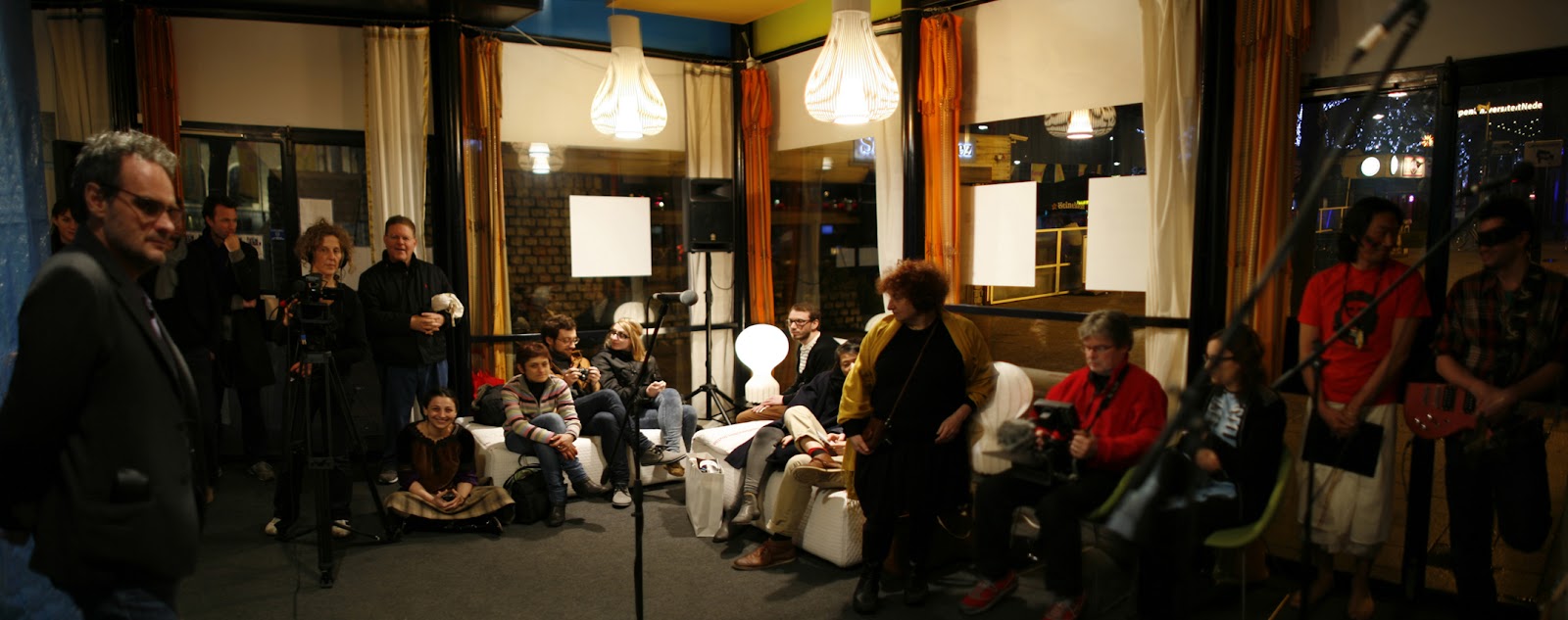

Photo : Attilio Maranzano
Tuesday, January 4, 2011
Notes Toward a Sympathetic Approach
From the first of these principles, namely the Law of Similarity, the magician infers that he can produce any effect he desires merely by imitating it: from the second he infers that whatever he does to a material object will affect equally the person with whom the object was once in contact, whether it formed part of his body or not. [...] Both [principles] assume that things act on each other at a distance through a secret sympathy, the impulse being transmitted from one to the other by means of what we may conceive as a kind of invisible ether.
-Sir James Frazer, The Golden Bough
Why do I find it beneficial to invoke—within the context of a group of artists, writers and curators assembled to consider issues surrounding speech acts and their documentation—a Scottish anthropologist’s theorization of magical practice dating from the early 20th century? First of all, I want to say that my intention here is not to simply replace the word “magic” with the word “art” as a kind of analog for the agency of the art object (although, when considered as a kind of materialist practice, Frazer’s notion of “sympathetic magic” preserves the agency of individual actors within a broader system of exchange). Nor do I wish to substitute the word “artist” for “magician,” thereby reproducing notions of artist-as-shaman, possessed though some inexplicable power by the secrets of the natural world. This kind of mystification would be extremely dubious, especially given the collective work of the Speech and What Archive. Instead, I want to invoke sympathetic magic as a potential way to reconsider the hierarchies that we have inherited from narratives that set the truth of reality against the falsity of its representations.
Frazer’s theorization of sympathetic magic thinks a world in which images/objects do not represent the things they depict, but rather are understood to be valences of them, distributed through a spatiotemporal network of sympathy and contagion. In other words, rather than reduced to a false image or a “mere” representation, the sympathetic image/object (in its life as material and image), is thought to contain something of the thing itself. It seems to me that this is how sympathetic magic can be productive with respect to discussions of documentation. Because, although it accepts causal relations, it resists a strictly ontological understanding. That is, it does not privilege reality over its image, nor the original event over its documentation. Instead, it prefers to concern itself with processes of transmission and translation, material contexts, embodiment and affective response. It is in precisely this way that the notion of sympathetic magic can provide an alternative to the document’s evidentiary capacities and internal problematics of truth/falsity, past/present and subject/object. The same kind of operation can be described with regard to the archive’s function as a representative totality. Instead of exhibiting the anxious drive to record, represent and preserve the way something really was (whether it be a person, an event or an epoch), a sympathetic approach in fact anticipates a fundamental instability, contradiction and loss. Nothing is true, everything is real. As part of a shared space of not-knowing, it becomes a generative framework, relying on the continued articulation of a collective memory, a contagious and excited state of fragmentation and contact.
Matthew Rana
Tuesday, November 16, 2010
Paris, explaining eels to contemporary art
On Friday Nov 12, A Constructed World invited Sébastien Pluot and Fabien Vallos (from SWA) and guest Sophie Auger to made a conversation about eating eels. This aperitivo event signified the end of 'Explaining contemporary art to live eels #6' an event curated by Pluot at Villa Arson earlier in the year.
Wednesday, October 13, 2010
London meeting
Speech and What Archive met at One Marylebone in London on October 16 for a conversation about ...
Sunday, October 10, 2010
Biennale de Belleville
Speech and What Archive performed, read, spoke and sang in the Speakeasy Medicine Show, an ACW event, at the Biennale de Belleville on 9 October.
A Floating Conversation
Performance #31 & 32, Adam & Eve
COLD Trailer
Vespétro
The Gift of Nothing
Lenny Bruce Monologue
The Nice Choir
A Floating Conversation
Performance #31 & 32, Adam & Eve
COLD Trailer
Vespétro
The Gift of Nothing
Lenny Bruce Monologue
The Nice Choir
Belleville meeting
Biennale de Belleville
The group met in Paris for four days. There was several meetings, rehearsals, two diners, and a night out in a bar of my neighborhood with lots of beer. It was good that even though we did'nt all knew each other, I felt that people sort of jumped in and accepted right away the presupposition of working in the context of the paper room event. It felt much more easy to speak together. Marie talked about common memory, which I guess is the reason why I am writing those words now. Anna talked about her editing projects, and about the kite that she had made in Bordeaux, and that had traveled to Melbourne the year before. Jesper talked about speaking to trees and to plants, the healing power of nature, and he had the project to take back in sweden with him a small tree from Paris that all of us could tell our faults and dark secrets to. Then in Sweden he would plant it in the ground to grow. I wonder if you can take a plant on a plane though. Matthew talked about performance and comedians, and Lenny Bruce of which he re-enacted bits of a performance he had once learned by heart. It was good to spend some time together an to make something together. I liked that other people were sort of connected to us in a way, as if we were part of a larger group. What I remember the most was the event itself, that seemed to fly by, and the tap dancing, and the singing. Especially the singing.
Clemence de Montgolfier
Friday, October 1, 2010
Speech and What Archive 2010

Subscribe to:
Posts (Atom)
